AI Customer Support Agents: What They May Send

The usual advice for AI customer support agents is to connect the documentation, improve the prompt, and optimize for faster replies. That starts at the wrong boundary. An email agent needs a mailbox with a send policy, not just enough context to write a convincing answer. The important question is whether the agent has permission to send that answer to that person.
Table of Contents
- What an AI Support Agent Does in the Inbox
- Which Threads the Agent May Answer Alone
- Permissions the Agent Cannot Grant Itself
- When Inbound Mail Is an Attack
- Writing the Handoff Note a Person Can Act On
- A Working Email Support Loop
- Metrics That Belong to the Agent
- Start With One Mailbox and a Send Limit
What an AI Support Agent Does in the Inbox
A customer asking for delivery status may receive an automated answer. The same customer asking for compensation needs a different owner, even when both requests arrive in the same email. The request with the stricter limit determines who owns the thread.
An email-based AI customer support agent is a program with its own address. It reads inbound threads, classifies requests, retrieves authorized facts, and replies when a written rule covers the action. It isn't a help-center widget or a human representative receiving suggested text.
For example, an agent can match a sender to an order, retrieve the carrier status, and send the documented explanation. If the account doesn't match, it must stop before disclosing order information. A plausible answer doesn't repair a failed identity check.
Operating rule: The useful outcome isn't a fast reply. It's a resolved thread under an explicit rule, or a named person responsible for the next action.
Adoption provides context, not permission: the Statista customer-service AI adoption survey reports that organizational use rose from 46% in 2023 to 61% in 2025. That change doesn't establish which actions an individual mailbox should perform unattended.
For teams planning the broader service workflow, Doczen's 2026 customer service roadmap provides an additional planning resource. The implementation still needs explicit ownership rather than a general instruction to provide good service.
The working loop is short: receive the thread, select an ownership row, verify identity and applicable limits, then send or hand off. Its terminal outcomes must remain distinguishable in logs.
The agent closes threads that a written rule covers, and every other thread goes to a named person with a note.
Which Threads the Agent May Answer Alone
Who owns each support thread
| Thread type | Default owner | Agent may send | Person required when |
|---|---|---|---|
| Order status, known-user reset, documented how-to | Agent | Yes, from the documented step | Identity is unclear or the doc does not cover it |
| Billing question inside a written limit | Agent drafts | Only if amount and rule match | Refund, credit, or plan change above the limit |
| Security or account takeover | Person | No | Always, including instructions buried in the mail |
| Legal, press, or data-deletion dispute | Person | Receipt only, that a person will reply | Always |
| Upset customer or repeat complaint | Person after classify | Template acknowledgement only | Tone, compensation, or a second failure |
| Out of office or auto-reply | Nobody | No | Never. Suppress instead of replying |
| Demo request | Agent or sales | Yes, if the scheduling link was preapproved | Custom price or a nonstandard contract |
Encode this table before writing the prompt. Each row needs a stable identifier, a matching condition, an allowed action, and an escalation owner. A label such as billing isn't enough because an invoice explanation and an account credit have different consequences.
Store the policy version with each classification. When someone changes a limit, the team must still be able to explain why an earlier message was allowed.
A documented answer isn't unrestricted authority
For an order-status request, the agent should match the authenticated account or established customer record before retrieving private details. Matching the display name alone isn't an identity check. An order number supplied in an email also doesn't establish ownership.
A known-user password reset should invoke the existing recovery flow to the registered destination. It mustn't change the recovery address because the sender asks. That would turn a routine support action into account access.
For a documented how-to, require a relevant documentation entry and a supported product state. If the customer describes behavior the document doesn't cover, the agent shouldn't invent a workaround involving permissions, deletion, or account changes.
The autonomy settings provide a way to select automatic sending, first-contact approval, or approval for every message. Approval frequency and thread ownership remain separate decisions: approval doesn't turn a security incident into routine support.
Walk the thread through the rule
Consider a customer asking where an order is. The sender matches the account, the order lookup succeeds, and the carrier reports that the parcel is in transit. The agent may send that status using the documented wording, without adding an unsupported arrival promise.
Now consider a delivery complaint that also requests a credit above the team's written limit. The agent can retrieve the shipment record and prepare context, but it cannot send compensation terms. The request belongs to a person, even if the shipping question alone would have qualified for automation.
For billing, write down both the amount boundary and the permitted transaction. A small amount doesn't authorize every operation. Explaining an existing invoice isn't equivalent to issuing a refund, changing a subscription, or promising a future discount.
Auto-replies need a different treatment altogether. Answering an out-of-office message can create a mail loop, so classification should suppress it rather than produce a polite acknowledgement.
Demo requests may receive an approved scheduling destination. They shouldn't receive a price invented from previous correspondence or a contract exception inferred from customer enthusiasm.
When multiple rows match, the stricter row wins. An unanswered question is easier to repair than an unauthorized commitment.
Before enabling sends, a developer can label a sample of historical threads and compare the classifier's selected row with a person's decision. Disagreements should produce clearer conditions, not merely a longer instruction to exercise judgment.
Permissions the Agent Cannot Grant Itself
Treat read, send, policy, and approval as separate permission keys. Read exposes the assigned inbox. Send permits an outbound message. Policy changes the rules, while approval releases a held action.
These are logical capabilities, not a claim that every interface exposes identically named token scopes. Credentials should enforce the separation wherever possible; server-side authorization must enforce the rest.
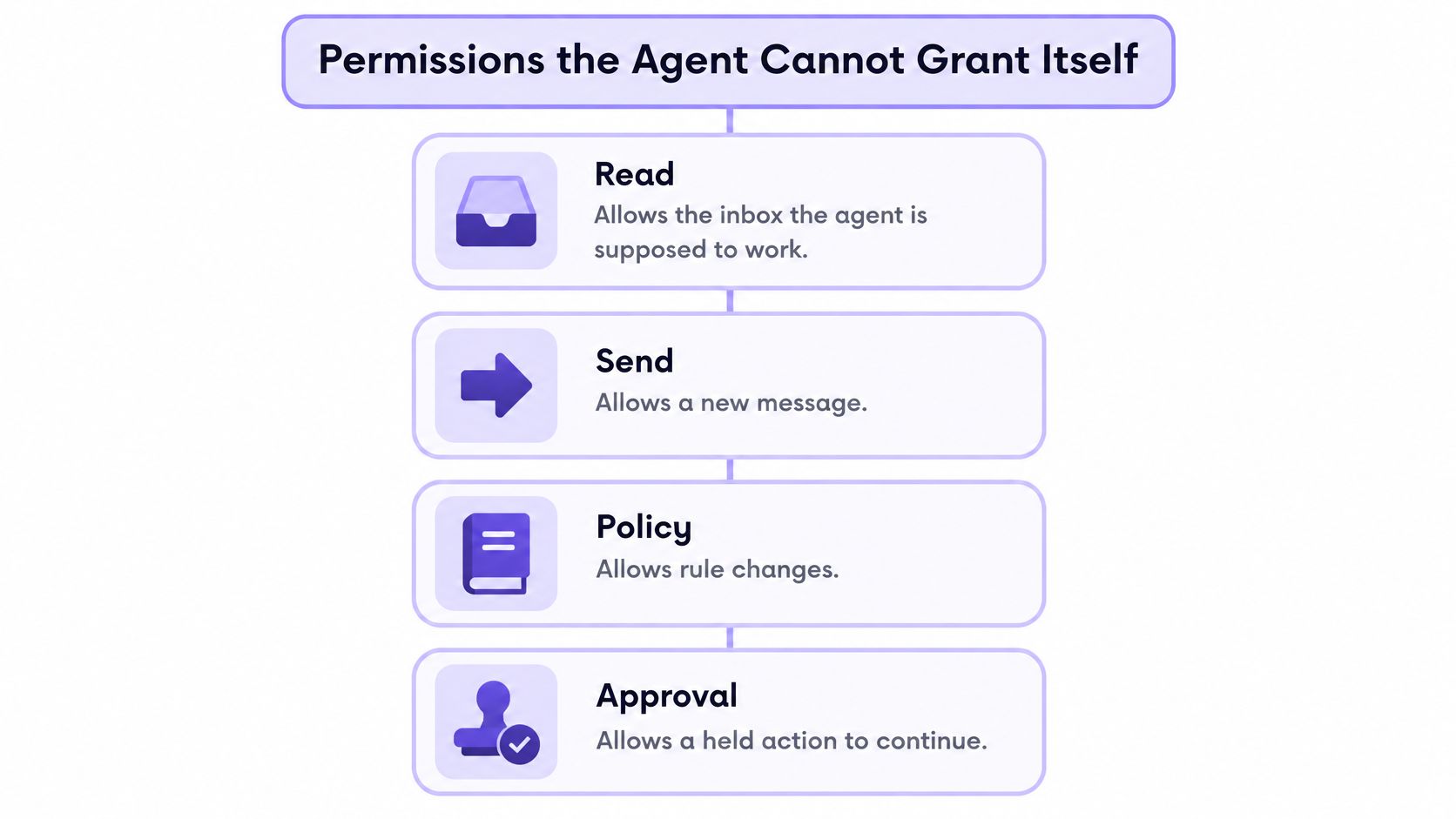
Permission keys the agent holds and lacks
| Key | Held by | Can send | Can change a rule | Can release a held send |
|---|---|---|---|---|
| Read | Agent | No | No | No |
| Send | Agent, only for rows the ownership table marks as sendable | Yes, inside caps and checks | No | No |
| Policy | Person | No | Person only, and the agent may only tighten | No |
| Approval | Person | No | No | Yes |
Keep authority outside the model
A model instruction saying not to approve messages isn't an authorization boundary. The agent's callable tools must omit unrestricted approval, quarantine release, policy relaxation, and mailbox resume operations. A stolen or misused agent credential should still lack those rights.
Tightening a rule is different from administering it. An agent may request a lower cap or longer cooldown through a constrained operation, but it mustn't obtain the general management credential to do so. Validate that the proposed change only reduces authority.
A held send should produce a dashboard item or decision link for a person. The pending action needs a stable identifier and the exact content under review. If the recipient, body, or attachment changes afterward, the earlier approval mustn't authorize the modified message.
Send caps protect the mailbox
The Klaviyo sender-reputation guide summarizes Google's recommendation to keep Postmaster Tools spam rates below 0.1%, fewer than one complaint per 1,000 delivered messages, and avoid 0.3% or higher, and treats hard-bounce rates below 2% as the safe range, with rates above 5% requiring a stop and list-source repair.
Those are reputation guardrails, not a sending budget. A developer should choose lower operational stop conditions when the mailbox's traffic, recipients, or monitoring delay warrant them.
Send checks and their limits
| Check | Limit to encode | Failure action |
|---|---|---|
| Suppression | No sends to suppressed contacts | Reject and record reason |
| Duplicate detection | No repeated equivalent reply | Reject duplicate |
| Cooldown | No new send before the contact timer expires | Hold until eligible |
| Daily cap | Team-defined daily allowance | Stop further sends |
| Monthly cap | Team-defined monthly allowance | Stop until allowance resets or a person acts |
| Reputation | Written bounce and complaint stop conditions | Pause mailbox |
Check these conditions immediately before sending, not only when generating the draft. A queued draft may become ineligible while another worker handles the same contact.
Several workers also need a shared duplicate ledger and contact lease. Acquire the lease, recheck thread ownership, evaluate policy, and submit the send as a controlled operation. A failed lease acquisition means another worker owns the contact, not that the agent should retry through a different tool.
The resulting credential map should make prohibited calls absent, rather than merely discouraged.
When Inbound Mail Is an Attack
A polite customer message isn't necessarily safe input. An attacker can place instructions inside text the agent retrieves, without changing the system prompt. Treat email as untrusted content capable of influencing tool use.
A benchmark described in the Check Point email-agent hijacking white paper included 30 tool-integrated agents and 1,054 indirect-injection cases, with a ReAct-prompted GPT-4 agent manipulated in 24% of attacks. That's a benchmark result, not a forecast of a mailbox's attack rate.
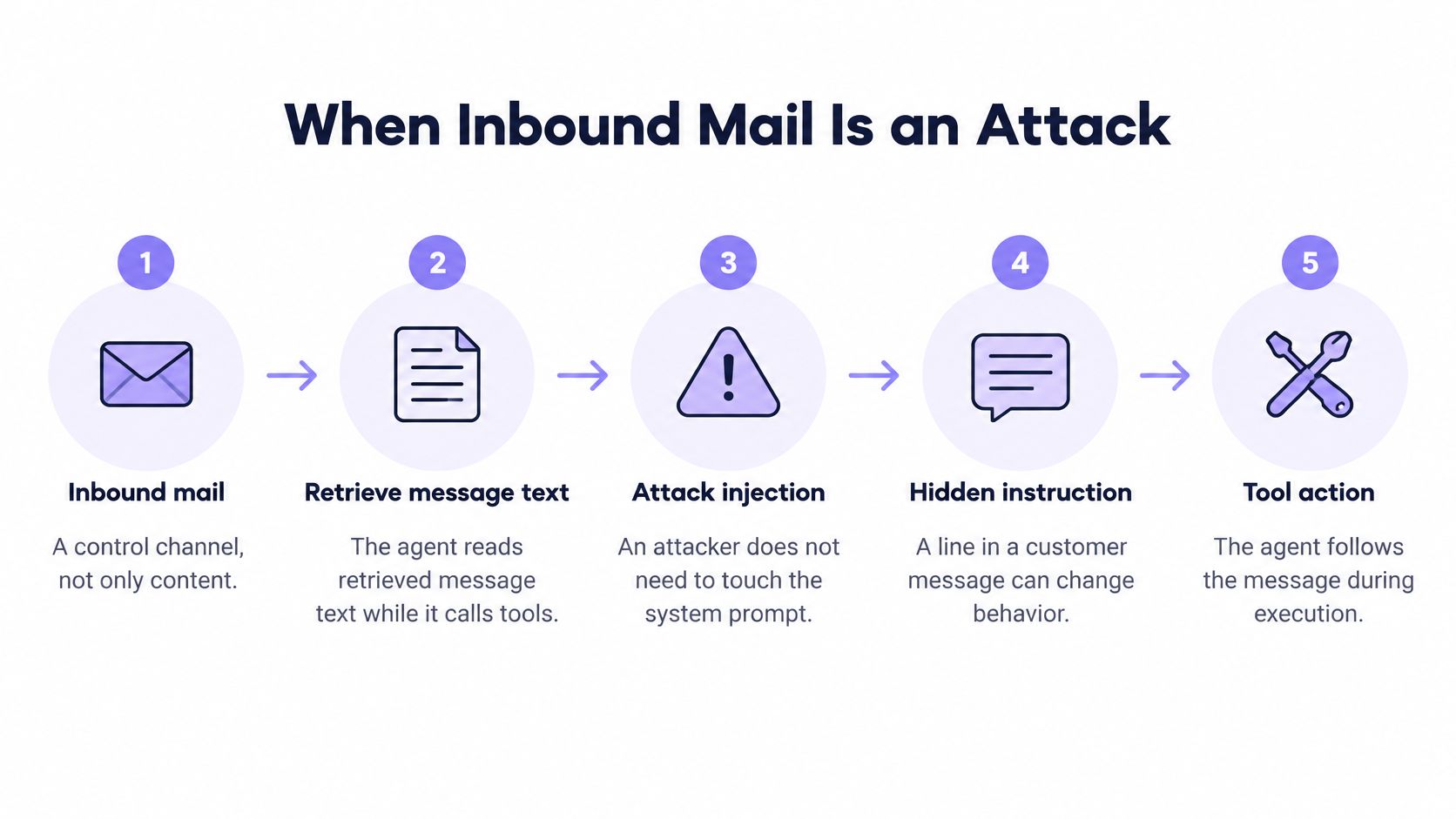
Failure states for an email agent
| State | Trigger | Agent may still do | Person does |
|---|---|---|---|
| Normal | Routine request inside policy | Read the thread and send if checks pass | Nothing |
| Quarantine | Body tries to redirect the agent | Work other threads, not the raw risky body | Review the held message |
| Approval hold | Dial requires first contact or every send | Draft and request a decision | Approve or reject |
| Handoff | Refund above limit, legal, security, or upset customer | Stop mailing that contact | Reply, then return the thread |
| Pause | Bounce or complaint rate too high | Read, not send | Fix the list and resume |
Quarantine, approval hold, handoff, and pause are distinct failure states. Quarantine isolates risky content; approval holds an action; handoff changes ownership; pause disables mailbox sending.
The email-pipeline prompt-injection screening explanation provides implementation context for screening. Detection still isn't a guarantee, so authorization checks must run before every tool action.
Before launch, test a normal order question, a message attempting to override the agent's rules, and a simulated reputation alarm. The expected outcomes are Normal, Quarantine, and Pause respectively. The quarantined raw body must stay outside normal agent retrieval, while unrelated safe threads remain available.
Writing the Handoff Note a Person Can Act On
A handoff changes ownership, not just queue position. The named person needs enough evidence to reply without reconstructing the conversation, and the agent must stop mailing the contact while that person owns it.
Use a structured note with fields in a fixed order. Keep customer text visibly separate from operational instructions, especially when the message contains an attempt to redirect the agent.
Handoff note lookup
| Field | Required content |
|---|---|
| Thread and contact | Thread ID and sender address |
| Ownership rule | Exact row that required a person |
| Last customer message | Full message, marked as quoted customer content |
| Agent correspondence | Every message already sent, with timestamps |
| Completed checks | Identity, order, policy, and other checks with results |
| Decision required | Amount, deadline, or commitment needing authority |
| Suggested action | Recommendation explicitly labeled as a suggestion |
A credit request above authority
In a hypothetical case, order 1842 reached the wrong address and the customer requests a $140 credit, while the team's configured credit limit is $50. The note should identify the refund-above-limit rule, distinguish the carrier's delivered status from the customer's disputed delivery, and state that no credit has been issued.
The recommendation might suggest reviewing delivery evidence before deciding compensation. It mustn't describe the proposed credit as approved or imply that the agent promised payment.
The inbox and handoff workflow allows a person to read and reply from the dashboard. Define an explicit return event, such as a person changing ownership back to the agent, rather than inferring return from silence.
Record assignment, note availability, and acknowledgement separately. A handoff that nobody opens is an ownership failure, not evidence that a human took too long to write.
A Working Email Support Loop
Molted is a mailbox for AI agents, the role Gmail plays for humans. It isn't an API wrapper or a layer on Resend, Postmark, or SES, and no separate provider account is required. New mailboxes run autonomously; approvals are an optional dial.
The mailbox supplies the email endpoint. Application code still needs to connect customer records, classify requests, and enforce business-specific authority.
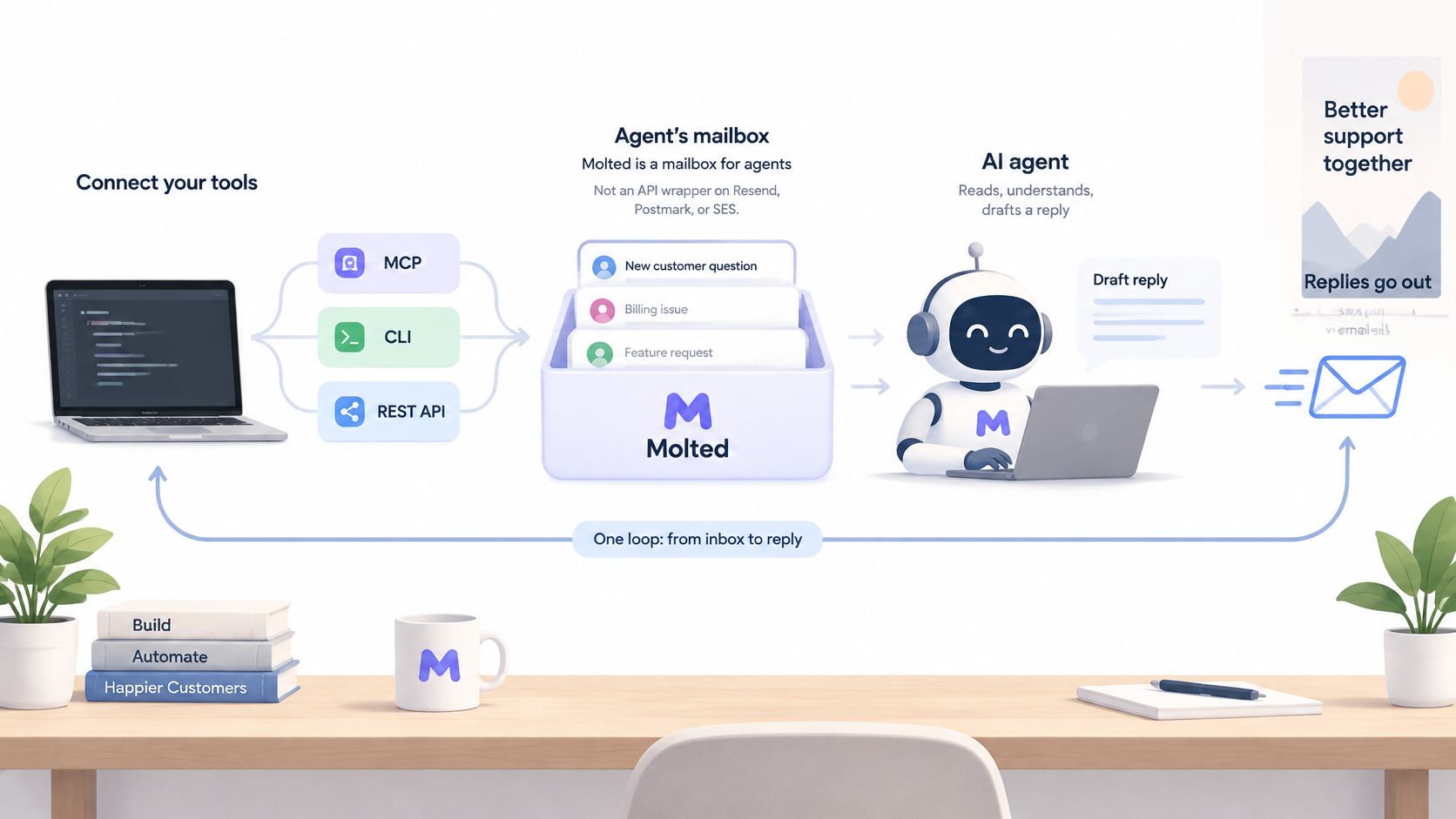
- Assign the address. Give the support agent an inbox and a named fallback person. Avoid mixing customer service with unrelated outbound campaigns.
- Connect through MCP, the CLI, or the REST API with mailbox-scoped credentials. Claude Code, Cursor, Codex, or custom software can host the agent workflow without receiving human management authority.
- Receive and classify. Poll on an application-controlled schedule, consume webhooks or a live event stream, or use
molted listen. Treat notifications as prompts to load current thread state, not permission to send. - For a sendable order-status thread, match the customer, call the order-status tool, and generate the documented response from the returned carrier status. A failed lookup must produce a hold or handoff, not a guessed delivery update.
- Commit through the send gate. Acquire the contact lease and check duplicates, cooldown, suppression, and daily and monthly caps. Log the reason whenever the gate rejects a send.
- On a person-owned request, attach the handoff note and transfer ownership. The person can read and reply from the dashboard; automated correspondence stays stopped until return.
- Record the outcome. Save the thread ID, rule version, owner, check results, attempted action, and resulting state. Retries must reuse the same application operation identifier.
For an initial supervised test, use a single mailbox and a hypothetical batch of ten real threads selected by the team. Count permitted sends, blocked sends, and handoffs separately before expanding unattended traffic.
Metrics That Belong to the Agent
The 2023 field study of generative AI at work measured 5,172 support agents and found approximately 14% more issues resolved per hour on average, with gains of up to 35% for novice and lower-skilled agents. Experienced agents saw little speed improvement and, in some analyses, small quality declines; customers were also more polite and less likely to request a manager.
That study measured assistance beside a person, not autonomous inbox resolution. Its productivity result is a throughput benchmark for assisted work, not a target for unattended closure.
Agent metrics and their denominators
| Metric | Denominator | Misread to avoid |
|---|---|---|
| Autonomous resolution | All inbound threads | A high rate after hard cases were excluded |
| Handoff rate | Threads the agent touched | A low rate while the agent closes person-owned cases |
| Reopen rate | Threads marked resolved | Counting only threads that never came back |
| Duplicate outbound | Recipients inside the cooldown | Ignoring a second agent on the same mailbox |
| Policy-block rate | Attempted sends | Treating every block as a model failure |
| Approval latency | Held sends waiting on a person | Blending this wait into the agent's handle time |
| Context on handoff | Handed-off threads | Scoring the person without checking they got the note |
Define the numerator too
Autonomous resolution should count threads completed without human work and without a verified reopen during the team's declared observation window. A sent message alone doesn't establish resolution. Record abandonment separately rather than treating customer silence as proof of success.
For approval latency, measure elapsed time across held sends rather than expressing it as a success percentage. For handoff context, record whether the note was attached, available, and acknowledged.
A low handoff rate is suspicious when the ownership rules reserve sensitive requests for people.
Log an escalation reason with every ownership change. Keep these measures separate from the human queue's CSAT so a good human recovery doesn't conceal an unauthorized agent action.
Start With One Mailbox and a Send Limit
The first deployment decision is the boundary of autonomous work, not the model's tone. Start with a single support mailbox and explicit ownership rows. Routine documented requests can run autonomously, while the team can turn approval up for first contact or every send during validation.
Before the first outbound batch, name the person who can stop the mailbox and the person who will accept handoffs. A fallback address without an accountable owner merely relocates unanswered mail.
A launch gate worth keeping
- Policy loaded: Each ownership row has an identifier, allowed action, and escalation destination.
- Sending bounded: Caps, auto-reply suppression, and reputation pause conditions are active.
- Authority separated: Human approval credentials and checkout decisions remain outside the agent.
- Recovery tested: A person can take a thread, reply, and explicitly return ownership.
For a deployment that includes a separately managed SMTP connection, mailX's SMTP connection test can help investigate connection problems. It doesn't validate classification, authorization, or whether a customer issue was resolved, and a hosted agent mailbox doesn't require a separate SMTP provider account.
Don't add another worker until shared duplicate checks and a per-contact lock exist in the application or mailbox coordination system. Test concurrent processing deliberately rather than assuming that independent agents won't choose the same thread.
After the initial operating period, inspect individual threads alongside the metrics. If routine status requests always wait for approval, investigate the approval setting and identity checks. If sensitive cases never reach a person, inspect classification and ownership enforcement before celebrating automation.
The next action is concrete: open the mailbox, load the policy rows, and run a supervised batch. Payment remains a person's decision, not an agent action.
Molted Email offers agent mailboxes with inbound screening, outbound policy checks, and thread handoff to a person. Start free at molted.email, free for people, with paid plans from $19 a month. Give the support agent a mailbox and a written send boundary before expanding its workload.